AI × Animals Weekly
Issue 1 · 13–19 November 2026
Subscribe
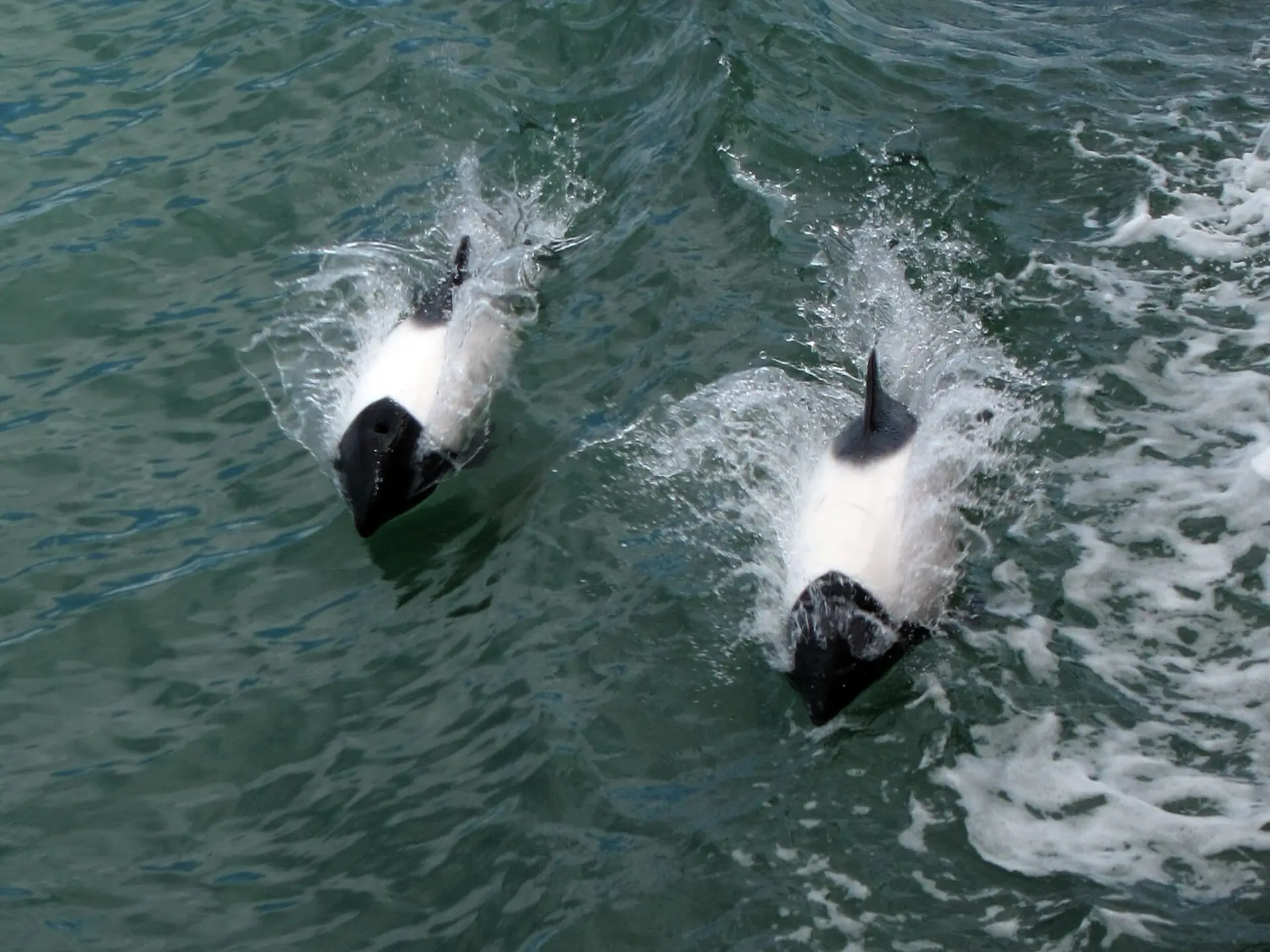
Two Commerson's dolphins surfacing in choppy water

Research & Data

New papers, open datasets and benchmarks, including studies that use research animals.

In this section
  1. Computer vision flags changes in animal behaviour
  2. Researchers test whether image models can distinguish closely related species
  3. Researchers compare ways to represent location in species maps
  4. Researchers test automated grading of canine mammary tumour slides
  5. Vet-OncoNet aligns tumour records from seven pathology laboratories
  6. Researchers automate dog heart-size measurements on chest X-rays
  7. Dog skin photo study finds performance falls on a stricter test
  8. Zhang and colleagues review how AI is entering veterinary education
  9. Udder thermal images add limited information in a one-herd mastitis study
  10. Researchers test smartphone photos for sorting mud crab maturity
  11. Researchers test drone images for estimating tilapia biomass
  12. Researchers identify small mammals from footprints on tracking plates
  13. Researchers use rabbit ultrasound to test liver-injury classification
  14. Kim and colleagues test phone images for flagging dental problems in dogs
  15. Li and colleagues review wearable sensors for assessing fatigue in sport horses
  16. Researchers test photo identification across 30 mosquito species
  17. Researchers review AI approaches to monitoring poultry health
  18. Lab Animal authors call for evidence when AI informs animal-use decisions
  19. University of Padua team evaluates AI for poultry disease surveillance
  20. Researchers combine machine learning and zebrafish experiments in heart-disease study
  21. Calf lung-sound study separates animals between training and testing
  22. Bee movement records reveal associations with colony survival
  23. Cattle posture model reports a strong benchmark with a familiar testing limitation
Research & Data · 1 of 23

Computer vision flags changes in animal behaviour

A research toolkit turns continuous footage into activity records and can notify staff when selected behaviours recur.

Note: Research using video of zoo and wild animals.

Researchers describe ROAM, a toolkit for reviewing animal behaviour from continuous video. The software classifies activity in a stream of footage and keeps a structured record of the observations. A research team can choose which behaviours to track and configure alerts for recurring activity.

The authors used polar bear monitoring to demonstrate the workflow, including counting repeated swimming laps. They also applied it to public footage datasets representing other species. The project documentation explains that those applications required changing the model weights and specifying the behaviours the team wanted to recognise.

Continuous footage can be difficult for people to inspect in full. The toolkit creates a record that can be compared with staff observations and reviewed when an alert is triggered. Its relevance depends on whether the selected behaviour can be recognised reliably in that setting.

Why it matters

Computer vision could help carers notice changes between observation sessions. Its value lies in flagging behaviour worth investigating; the animal’s circumstances still matter more than an alert alone.

Research & Data · 2 of 23

Researchers test whether image models can distinguish closely related species

PS-SPLIT tests category discovery on a task inspired by how taxonomists separate closely related species.

Note: Accepted at NeurIPS 2026 (Evaluations and Datasets Track), according to the authors’ arXiv listing. The benchmark uses existing bird photographs.

Lange and colleagues introduce PS-SPLIT, an image benchmark inspired by taxonomic splitting. Taxonomists sometimes find that populations previously grouped together actually represent distinct species. The benchmark uses this idea to construct tasks where a visual model must discover distinctions within a group.

The authors argue that widely used category-discovery benchmarks have become less useful for separating competing methods. Closely related animals can share many visual traits. In this setting a model must make sense of subtle variation, rather than relying on differences that are easy to see between broad categories.

The work provides an evaluation setup for comparing methods on the same problem. Visual clustering can suggest which images deserve closer inspection, while taxonomic decisions may also depend on genetic, geographic and other evidence.

Why it matters

Better image models could help biodiversity researchers identify animals that look alike. This benchmark tests that ability; it does not yet show a benefit for conservation in the field.

Research & Data · 3 of 23

Researchers compare ways to represent location in species maps

The study sets out an evaluation framework for the geographic inputs used by species distribution models.

Note: Accepted at the NeurIPS 2026 Workshop on Tackling Climate Change with Machine Learning, according to the authors’ arXiv listing.

Lange and Mac Aodha compare how species distribution models represent the places where observations are collected. Distribution modelling uses incomplete reports of where a species has been observed to estimate its likely range in areas with fewer records.

The comparison considers several ways to describe a place, including climate variables, transformed coordinates and learned geographic representations. The authors set out a common evaluation framework for both local and global settings so that choices about the inputs can be studied separately from choices about the model.

An estimated range can change when the geographic inputs change, particularly where observations are sparse. Testing inputs alongside the model gives researchers a way to see which assumptions matter in different settings and to plan where new field observations may be needed.

Why it matters

How AI represents location can shape predictions of where animals occur. Testing those choices could improve fieldwork planning, provided uncertainty stays visible and predictions are checked against observations.

Research & Data · 4 of 23

Researchers test automated grading of canine mammary tumour slides

The model agreed with a veterinary pathologist consensus on most of a small independent set of dog slides.

Note: Feasibility study on animal tissue slides.

Researchers tested whether a deep-learning system could reproduce the overall histological grade assigned to canine invasive mammary carcinoma. The system works on digitised slides and scores the three components used in the Nottingham grading approach, including the shape of tumour nuclei and indicators of cell division.

The team evaluated the system on 29 independent dog slides against the consensus of two veterinary pathologists. Overall grade agreement was 93.1%. Agreement was lower for individual components, including 72.4% for the nuclear appearance score.

The authors also explored how the system performed on seven cat slides that had not been used to train or validate it. That small exploratory set and the limited dog test set leave open how the tool would perform across laboratories and scanning systems.

Why it matters

Agreement on one overall score can conceal differences in the individual judgments that make up a pathology grade.

Research & Data · 5 of 23

Vet-OncoNet aligns tumour records from seven pathology laboratories

The system combines reusable expert decisions, machine-assisted coding and manual review for uncertain entries.

Note: Research using veterinary pathology records.

Katia Pinello and João Niza-Ribeiro describe a way to pool veterinary pathology records while retaining the entries as originally submitted. Labs use different terms for where a lesion was found and what it was. The framework interprets those two fields together so it can assign more consistent tumour codes.

The system reuses decisions already checked by an expert. It assesses unfamiliar combinations computationally and refers uncertain cases for expert review. The authors report that 58,491 records remained traceable in the combined dataset after exclusions. Of these, 50,616 followed an automatic route, mostly through an existing expert decision.

The paper describes an operating data pipeline and the dashboards it supports. The authors say an independent evaluation is still needed to establish coding accuracy.

Why it matters

Making records comparable across labs can support surveillance of animal cancers, provided investigators can trace the standardised entries back to the original records.

Research & Data · 6 of 23

Researchers automate dog heart-size measurements on chest X-rays

The method estimates two standard measurements from complementary views and compares its results with human measurements.

Note: Research using animal radiographs.

Researchers built a system to measure the size of a dog’s heart from common chest radiographs. In a side view, the software relates the outline of the heart to the length of structures along the spine. From views taken through the chest, it estimates how wide the heart is relative to the chest.

In separate test images the authors compared the automated measurements with manual references. Their reported intraclass correlation coefficients were 0.8744 for measurements based on the spine and 0.7928 for the heart-to-chest ratio. These statistics describe agreement under the study design.

The work addresses a measurement task. It does not establish that the system diagnoses heart disease or that it will agree with every clinician in routine use.

Why it matters

Automating routine measurements could help vets compare scans more consistently while leaving clinical interpretation with the treating team.

Research & Data · 7 of 23

Dog skin photo study finds performance falls on a stricter test

Researchers grouped images by source to reduce the chance that near-duplicates appeared in both training and testing.

Note: Research using animal images. Independent clinical validation remains pending.

Researchers trained models to classify dog skin photographs and tested how the results changed when images from the same source were kept together. The team audited image similarity and used source information to separate training and test material. That matters because near-duplicate photos can make a model look more capable than it is when it sees a genuinely unfamiliar case.

The selected model scored 94.62% balanced accuracy during cross-validation. It reached 78.06% on the separate internal test of 226 images. Balanced accuracy gives equal weight to the categories even when the dataset contains more examples of some conditions than others.

The images came from repositories. The authors call for independent testing on clinically annotated images before making claims about performance in real clinics.

Why it matters

An evaluation split that keeps related images together gives readers a better idea of where an image classifier may fail.

Research & Data · 8 of 23

Zhang and colleagues review how AI is entering veterinary education

A narrative review describes potential teaching uses and finds limited evidence about student outcomes.

Note: Narrative review.

Xu Zhang and colleagues reviewed how AI is being used or proposed for veterinary training. Their examples include anatomy, image interpretation, clinical simulations and use of language models. They argue that students will need to understand how these tools produce outputs and recognise when those outputs are unreliable.

The paper distinguishes documented teaching use from proposals and from examples drawn from human medicine. It also notes that evidence for measurable gains in veterinary education is limited. The work is a narrative review, with studies selected for their relevance rather than combined to estimate an overall effect.

The authors provide examples of their search strategy but say they did not retain a complete record of screening and exclusions. That limits what can be inferred about how comprehensively the paper represents the literature.

Why it matters

Assessing AI as a clinical tool is a different skill from using it as a learning aid; curricula can make room for both.

Research & Data · 9 of 23

Udder thermal images add limited information in a one-herd mastitis study

A model’s sensitivity fell sharply during internal testing; milk cell counts supplied most of the predictive information.

Note: Research involving a single herd of dairy cows.

Researchers followed 89 lactating cows at one farm to see whether udder surface temperature helped identify mastitis without visible signs. They combined thermal measurements with variables including somatic cell count, a measure related to inflammation, and compared predictions with outcomes from milk samples.

Sixty-one of 530 quarter-level samples were positive. The binary model had an area under the ROC curve of 0.96 on the development data and 0.81 in internal cross-validation. At the study threshold, sensitivity fell from 90% to 33%. The authors say cell counts supplied most of the predictive information.

The findings apply to this herd and evaluation protocol. They support investigating what thermal images add to existing measurements, rather than judging the images by the model’s development result alone.

Why it matters

An early-warning system has limited practical value if it misses many of the cases it is intended to flag.

Research & Data · 10 of 23

Researchers test smartphone photos for sorting mud crab maturity

A model trained on one lighting setup performed worse when tested on photographs taken under another.

Note: Research involving live farmed mud crabs.

Researchers tested whether models could distinguish immature and mature female mud crabs from smartphone photographs of live animals. They compared two lighting setups and used labels agreed by aquaculture experts as the reference. Their dataset contained 2,000 images split evenly between the two setups.

The highest mean accuracy approached 99% when training and testing used the same kind of image. When a model trained on the first setup was tested on the second or vice versa, accuracy ranged from about 69% to 89%, depending on the direction and model. Training with both kinds of photograph improved performance on the corresponding test subsets.

The results describe the conditions the researchers tested. They leave open how well a field tool would transfer to other devices, lighting and farms.

Why it matters

Reliable non-destructive assessment could reduce the need to open an animal to inspect its ovaries.

Research & Data · 11 of 23

Researchers test drone images for estimating tilapia biomass

In a four-unit pilot, an image-based biomass estimate was less accurate against harvest weights than simpler baselines.

Note: Research involving farmed tilapia.

Researchers tested a drone and computer vision workflow for counting fish and estimating how much tilapia a production unit contained. The system identified fish in overhead images and used geometrical calibration to estimate body length. The team compared the results against manual counts and measured weights.

Automated and manual counts differed by one fish in a comparison involving 547 fish. Estimating total weight was harder. Across four units, the last image-based estimates differed from the following week’s harvest weights by 9.3% on average in percentage-error terms. Simpler baselines without imagery had errors of 4.1–6.3% in that comparison.

This was a small farm study. The results suggest counting and estimating weight are distinct jobs; the strong comparison for one cannot be assumed for the other.

Why it matters

Alternatives to repeated weighing could reduce handling, but a useful estimate must hold up against the simpler methods farms already use.

Research & Data · 12 of 23

Researchers identify small mammals from footprints on tracking plates

A South African study tests whether computer vision can turn small footprints into usable records of species presence.

Note: Research involving identified small mammals.

Researchers collected trackplate prints from identified small mammals at five sites in South Africa and built a labelled image library. They wanted to test whether a model could distinguish species from a print, including when the print was partly visible or turned at an angle.

The team evaluated 3,355 footprint images from 122 usable plates representing 11 species. It kept prints from individual plates together during cross-validation so the model was tested on plates it had not already seen. Mean accuracy was 89.2%. The authors found that errors were concentrated among species with similar footprints.

The study compares images within its regional data from South Africa. Tests on new sites and species would help determine where the approach can support routine surveys.

Why it matters

Trackplates can capture evidence of small mammals without relying on seeing the animal directly; image review is one of the steps that affects how much survey data can be used.

Research & Data · 13 of 23

Researchers use rabbit ultrasound to test liver-injury classification

The experimental study measures how well a model detects signs of blunt injury in ultrasound images.

Note: Laboratory-animal study involving experimentally induced injury in rabbits.

Researchers assessed whether a deep-learning model could recognise ultrasound signs of blunt liver injury. The study used 54 laboratory rabbits imaged before and after experimental injury. The authors compared the ultrasound results against observations made as part of the animal study.

The model identified the presence or absence of an injury site with 86.4% accuracy under the study conditions. Its accuracy for classifying injury severity was 73.2%. These are separate tasks and the article reports different measures for detecting blood in the abdomen.

The publisher describes the paper as peer-reviewed and accepted, made available ahead of its final edited version. The experiments were designed around controlled animal models. The study does not establish how the system would perform on trauma scans in clinical settings.

Why it matters

Detecting a visible injury and grading its severity place different demands on an ultrasound system.

Research & Data · 14 of 23

Kim and colleagues test phone images for flagging dental problems in dogs

The models classified visible tartar and gum inflammation in separate image sets from veterinary hospitals.

Note: Retrospective study using animal photographs. Results are from the author abstract.

Pureum Kim and colleagues trained image classifiers to identify visible tartar and gum inflammation in photographs of awake dogs. The retrospective dataset came from 12 veterinary hospitals and included 3,170 dogs. Images were labelled by one veterinarian, and the training and test splits were grouped by dog.

The classifiers reported 96.9% accuracy for tartar in a test set of 320 images and 92.0% for gum inflammation in a separate set of 250 images. Those figures describe image classification under the study design. The tasks used different numbers of images.

The authors describe the work as a possible screening aid. The study does not establish that phone images can reveal problems hidden beneath the gumline or replace a veterinary examination or dental radiographs.

Why it matters

The photographic assessment concerns what is visible in the image. A clinic still needs other information to assess oral health.

Research & Data · 15 of 23

Li and colleagues review wearable sensors for assessing fatigue in sport horses

The review compares signals such as heart rate, temperature and movement, and calls for clearer definitions of fatigue.

Note: Review of research involving horses and wearable sensing.

Li and colleagues reviewed 102 publications on horse fatigue, sensing and related machine-learning methods. They considered how heart activity, temperature, motion sensors, muscle electrical signals and GPS have been used to describe the physical demands faced by sport horses.

The review found that each signal captures a different aspect of exercise or recovery. The authors describe opportunities for combining signals but identify a lack of consistent definitions, strong external evaluation and studies that follow the same horse over time. Differences between disciplines also matter.

The paper is a synthesis of research rather than a head-to-head trial of commercial devices. Its recommendations concern how to design and judge future studies, including whether a model’s output is interpretable enough to inform training decisions.

Why it matters

Fatigue is a welfare and performance concern, but an individual sensor reading needs the context of the horse and the exercise.

Research & Data · 16 of 23

Researchers test photo identification across 30 mosquito species

The study compares image models for classifying species when labelled examples are scarce or unevenly distributed.

Note: Research using mosquito specimen images.

Taxonomic identification of mosquitoes can depend on characteristics that are difficult to distinguish in an image. Researchers assembled 1,705 cropped images representing 30 species and compared models for classifying the specimens. Some species were represented by far more examples than others.

The authors examined whether a model that had already learned broader image features could be adapted to a smaller labelled collection. They compared model performance with different amounts of training data and reported several metrics, recognising that a high overall score can mask poorer results on less common species.

The paper is an image benchmark. It does not show that the system can identify mosquitoes across all field settings or that it has been evaluated on live field collections outside the study design.

Why it matters

Surveillance teams often need to identify species from limited material. The distribution and quality of reference images influence how far automated identification can help.

Research & Data · 17 of 23

Researchers review AI approaches to monitoring poultry health

A narrative review compares evidence from cameras, sound and other sensors and highlights the need for validation on farms.

Note: Narrative review of research involving poultry.

A review in Frontiers in Animal Science maps the ways researchers have used AI to study flock health. The review covers cameras, acoustic signals and combinations of information from multiple sensors. It also discusses the difference between running a model at a farm and processing the data elsewhere.

The authors describe how behaviours and environmental conditions can change the meaning of the same signal. Their review draws together examples of research rather than measuring the effect of installing one tool in otherwise comparable poultry houses. It flags data quality and model evaluation as areas where research still needs to improve.

One practical question is whether performance measured in a study holds when birds, housing, equipment and background noise differ. The review treats that as a challenge for deployment rather than a settled finding.

Why it matters

Farm staff need to know what a health alert represents and whether it will remain useful outside the setting where the model was evaluated.

Research & Data · 18 of 23

Lab Animal authors call for evidence when AI informs animal-use decisions

An opinion article applies the principles of replacement, reduction and refinement to AI tools used in research.

Note: Opinion article about animal use in research.

Sally Thompson-Iritani and Oliver A. Garden ask how scientists should evaluate AI tools that influence decisions about research animals. It frames the question around the three Rs: replacing animals where possible, reducing the numbers used and refining their care and procedures. The authors distinguish applications already in use from proposed benefits that have yet to be demonstrated.

The authors argue for assessing changes that can actually be observed for animals and science. They also call for informed human judgment when an AI output influences an animal-use decision. The piece sets out an evaluation perspective rather than testing one tool or estimating how much animal use any particular model would avoid.

The article’s scope spans multiple research settings. Its conclusions are arguments about responsible evaluation, rather than findings from a new animal experiment.

Why it matters

An AI-assisted decision is relevant to animal welfare when researchers can explain what it changes and how they know.

Research & Data · 19 of 23

University of Padua team evaluates AI for poultry disease surveillance

Researchers compared computer classifications of a poultry virus with groupings assigned by earlier genetic analyses.

Note: Research using existing animal-health surveillance data.

Giovanni Franzo and colleagues at the University of Padua evaluated machine learning for classifying infectious bursal disease virus. The disease can suppress chickens’ immune systems. Classifying records consistently can help surveillance teams compare what is circulating across places and over time.

The study used existing sequence records and treated classifications assigned by earlier genetic analyses as the reference. The best-performing models showed high agreement with those assignments across the checks reported. The authors also examined whether performance held when they separated records collected in different places or years.

The available records reflect where previous investigators sampled and shared their data. The authors caution that the dataset may not represent the global spread of the virus. The study evaluated classification on existing records and did not test clinical outcomes on farms.

Why it matters

Consistent classification can support comparisons in poultry surveillance when laboratories know how well the reference data represents the populations they monitor.

Research & Data · 20 of 23

Researchers combine machine learning and zebrafish experiments in heart-disease study

An accepted paper identifies candidate genes in human data and investigates related biological effects in a fish model.

Note: Research involving zebrafish experiments and human specimens. Based on the published author abstract.

Jue Gu and colleagues used machine learning to investigate genes linked to fat-cell development in coronary artery disease. The team analysed existing human gene-expression data, selected candidate markers and compared molecular groupings among patients. They also collected clinical specimens and constructed a zebrafish model.

The published author abstract reports higher serum levels of the selected markers in patients with coronary artery disease, consistent with the direction of the computational findings. The zebrafish work explored links with lipid metabolism and blood vessels. The authors describe the genes as possible targets for future investigation.

The publisher released the accepted, peer-reviewed article on 19 November ahead of final editing. The accessible summary gives no sample denominator or independent clinical performance estimate. It supports a preliminary account of the combined computational and animal work, with further interpretation dependent on the full methods and results.

Why it matters

The study shows how a computational hypothesis can lead into animal experiments. Its reported associations leave the clinical usefulness of the proposed markers to be established.

Research & Data · 21 of 23

Calf lung-sound study separates animals between training and testing

Researchers test an audio classifier while keeping recordings from each calf together.

Note: Research involving live calves, gently restrained for recordings. Peer-reviewed proof of concept; internal validation.

Salvatore Ferraro and colleagues assessed machine learning for distinguishing normal and abnormal calf lung sounds. They collected recordings in Canada, Italy and Sweden, then screened their quality and removed ambiguous examples and duplicates.

The final dataset contained 380 recordings from 230 calves. The researchers kept each calf’s recordings together when separating training and testing, reducing the risk of a model recognising the same animal across both sets. On 76 held-out recordings from 45 calves, the selected classifier achieved 81.6% accuracy.

The task was to reproduce expert acoustic categories, rather than establish disease from a definitive clinical test. More detailed sound classification was less reliable. Most original recordings failed the initial quality screen, and independent validation remains necessary before routine clinical use on farms.

Why it matters

The study makes animal separation and recording quality central to evaluating a potential screening aid.

Research & Data · 22 of 23

Bee movement records reveal associations with colony survival

A survival-modelling study examines commercial colony movements without establishing cause and effect.

Note: Observational research using colony records. Based on the author abstract and publisher disclosures.

Nico Coallier and colleagues analysed commercial beekeeping records to investigate how colony movements relate to survival. Their dataset covers 362,884 colonies managed by 62 beekeepers between 2022 and 2026. They compared machine-learning survival models and an ensemble, then used the selected approach to explore movement scenarios.

More frequent transportation was associated with a lower probability of survival beyond one season. Longer average intervals between moves were associated with greater predicted longevity. These are associations in recorded operations, rather than evidence that changing a movement schedule would produce a particular survival benefit.

The accessible accepted article does not fully measure weather, colony health or floral resources, all of which could influence the results. Two authors work at Nectar Technologies. The publisher identifies the paper as peer-reviewed and accepted, with editing still to follow.

Why it matters

The work offers a way to investigate commercial records while leaving management recommendations dependent on stronger causal evidence.

Research & Data · 23 of 23

Cattle posture model reports a strong benchmark with a familiar testing limitation

A lightweight vision system recognises four postures, but similar video frames can occur on both sides of the test split.

Note: Research using cattle images and video. Peer reviewed; performance is a detection benchmark, without a measured welfare benefit.

Shi Ju and colleagues developed Cattle-YOLO to recognise walking, standing, eating and lying in cattle images. Their dataset combines farm footage, public images and aerial material across different monitoring conditions. It contains 1,923 annotated frames with 12,936 cattle instances.

The model reported 95.8% mean average precision at an intersection-over-union threshold of 0.5. That detection metric summarises performance across the posture classes; it does not mean the system diagnosed disease with that accuracy. The researchers also tested deployment on compact computing hardware.

The paper acknowledges that random frame splitting can put highly similar frames from one video into both training and testing. This may overstate performance on genuinely new footage. Difficult examples were filtered during annotation, and some original farm imagery is restricted, further limiting what can be independently reproduced.

Why it matters

Continuous posture monitoring could support observation, but new-farm testing is needed to establish practical reliability.

Also this week in Research & Data

Other animal news from the week with little or no AI angle. Links go to the original source.

  • 16 Nov 2026
    Swedish researchers examine behaviour in German shepherds

    The Swedish University of Agricultural Sciences reports associations between genetic variation and behaviours including curiosity and fearfulness. Source: SLU news, 16 Nov 2026

  • 13 Nov 2026
    Dog behaviour study compares responses after play and separation

    In a small study of 16 pet dogs, the animals spent more time attending to a lion-growl recording after brief separation from their owners than after play; the authors call for larger studies. Source: Animal Welfare, Cambridge Core, 13 Nov

  • 18 Nov 2026
    Drone sampling study reports a respiratory baseline in wild dolphins

    Dugény and colleagues collected exhaled material from wild bottlenose dolphins in Greece and used environmental controls to distinguish sample signals from surrounding air and seawater. Source: Frontiers in Veterinary Science author abstract

  • 16 Nov 2026
    Lab Animal commentary revisits tools for better animal-study design

    Pearl, Menon and Smith discuss resources for planning research, considering alternatives to animal use, preregistering studies and making methods and results easier to inspect. Source: Lab Animal, 16 Nov

  • 17 Nov 2026
    CITES records suggest a limited link between captive breeding and wild reptile trade

    Wang, Meng and Carrasco analysed trade reported from 1991 to 2024. Rising captive-bred supply was associated with a small decline in reported wild-sourced trade in the following year. Source: Authors’ Conservation Biology abstract, republished by the Pacific Islands Protected Area Portal

  • 18 Nov 2026
    Interviews reveal different understandings of the three Rs in animal research

    Rodriguez and colleagues interviewed 89 professionals involved in Swiss animal research. Their qualitative study examines how people apply replacement, reduction and refinement across scientific, ethical and public-policy roles. Source: Frontiers in Veterinary Science, 18 Nov

  • 13 Nov 2026
    Researchers test an image-based proxy for flying-insect diversity

    Researchers scanned sticky traps from Israeli agricultural and natural habitats, detected insects with machine learning and compared visual diversity with expert taxonomy. The author abstract reports an association but provides no validation-set size or numerical correlation. Sticky traps capture and kill insects. This study has not yet been peer reviewed. Source: Author manuscript and dated bioRxiv API, 13 Nov

  • 17 Nov 2026
    Hybrid insect distribution models combine experiments and occurrence records

    Researchers compared mechanistic thermal models, deep learning and combinations of the two for six insect species. The author abstract reports that hybrid approaches were less sensitive to missing occurrence records. The models use historical environmental and experimental information; no field management benefit is established. This study has not yet been peer reviewed. Source: Author manuscript and dated bioRxiv API, 17 Nov

  • 19 Nov 2026
    ZoionNET manuscript describes acoustic alerts for animal intrusion

    Vijay and colleagues describe a battery-powered node that classifies animal sounds and sends cellular alerts. The manuscript was submitted this week and refers to hardware recognised in a 2024 student competition. Its proposed energy advantage has not been measured. Abstract accuracy claims lack test denominators and are omitted. This study has not yet been peer reviewed. Source: Author manuscript, submitted 19 Nov

  • 18 Nov 2026
    Simple movement summaries challenge trained behaviour encoders

    Researchers compared fixed movement measurements with trained representations on mouse, fly and synthetic-motion benchmarks. Their author abstract reports stronger results for the simpler baseline on several tasks, with exceptions for short movements. This is a benchmark comparison using existing datasets. This study has not yet been peer reviewed. Source: Author manuscript and arXiv dated API, 18 Nov

  • 17 Nov 2026
    Rat locomotion model links simulated spinal circuits and movement

    Researchers introduce a biomechanical rat simulation and neural controller informed by mammalian spinal circuitry. The author abstract reports simulated gait patterns consistent with experimental observations. It does not establish that the model replaces live-animal experiments. This study has not yet been peer reviewed. Source: Author manuscript and arXiv dated API, 17 Nov

  • 17 Nov 2026
    Broiler behaviour model is converted for an Android app

    Researchers trained a vision model on publicly available chicken videos to classify sitting, standing and feeding. The author abstract reports weaker feeding detection, including recall of 0.20 on its reported evaluation. Independent commercial-farm validation is not established. This study has not yet been peer reviewed. Source: Author manuscript and arXiv dated API, 17 Nov

  • 13 Nov 2026
    Bloom learns shared representations from mouse brain-cell data

    Researchers describe a transformer trained on 300,000 adult mouse brain cells with paired molecular measurements. The author abstract reports comparisons with other cell models for annotation and related tasks. This is computational work on animal-derived data, with biological hypotheses still requiring testing. This study has not yet been peer reviewed. Source: Author manuscript and dated bioRxiv API, 13 Nov

  • 18 Nov 2026
    REGAL designs tissue-specific regulatory sequences across species

    Researchers use reinforcement learning to design enhancer arrangements. Their author abstract describes experimental work in transgenic mouse embryos, zebrafish and fruit flies, alongside human-cell comparisons. Animal numbers and full validation details were not accessible in this pass. This study has not yet been peer reviewed. Source: Author manuscript and dated bioRxiv API, 18 Nov

  • 19 Nov 2026
    NeuroImgAgent proposes checked workflows for cross-species brain imaging

    Researchers describe language-model agents for human, macaque, rat and mouse imaging workflows, with checks that can continue processing, attempt recovery or stop. The author abstract reports expert assessments of processing outputs. This concerns analysis quality rather than a demonstrated reduction in animal use. This study has not yet been peer reviewed. Source: Author manuscript and dated bioRxiv API, 19 Nov

  • 18 Nov 2026
    Resistance genes support experimental attribution of bacterial sources

    Researchers used resistance-gene profiles to classify Acinetobacter baumannii genomes from people, companion animals, soil and white storks. The author abstract reports markedly poorer performance for soil and stork sources than for the other groups. Source association does not by itself establish transmission direction. This study has not yet been peer reviewed. Source: Author manuscript and dated bioRxiv API, 18 Nov

  • 17 Nov 2026
    Survey examines recurring piling in cage-free hens

    Mazocco and colleagues surveyed 90 respondents; 83 reported piling and 57 of those described recurrent episodes. The study found no clear association with the tested flock-size, nest or lights-off categories. The authors call for prospective measurements before proposed conditions are treated as risk factors. Source: Peer-reviewed author abstract, 17 Nov

  • 18 Nov 2026
    Housing study examines barriers to accommodating pets

    Researchers interviewed 13 people experiencing homelessness and 23 service professionals in the UK. The study describes how buildings, resources and decision-makers’ attitudes shape pet inclusion. Participants valued animal companionship while identifying welfare and practical concerns. Qualitative interviews do not establish national prevalence. Source: Peer-reviewed author abstract retrieved through Crossref, 18 Nov

  • 17 Nov 2026
    Viewers struggle to identify suffering in animal entertainment images

    A study compared 100 lay participants with 156 veterinary students evaluating images and videos of dogs, cats and rabbits. Both groups missed some welfare problems and expressed uncertainty. The findings concern interpretation of the selected material, rather than the prevalence of harmful posts across social media. Source: Peer-reviewed study, 17 Nov

  • 16 Nov 2026
    Small chicken study tests gradual dawn and dusk lighting

    Researchers observed six laboratory-housed chickens before and after adding lamps that gradually changed light levels. They reported changes in startle, stretching and perching behaviour consistent with more natural daily transitions. This small pilot involving live animals provides preliminary evidence, without a commercial-flock trial. Source: Peer-reviewed study, 16 Nov

  • 18 Nov 2026
    Authors argue for welfare assessment throughout wildlife trade

    A published analysis applies the Five Domains model to bears used in traditional medicine, dolphins used for entertainment and mink farmed for fur. The authors argue that individual welfare should inform trade decisions alongside population conservation. This is an interpretive analysis of existing evidence. Source: Peer-reviewed author abstract, 18 Nov

  • 16 Nov 2026
    SCOUBI analyses RNA outside mouse brain-cell bodies

    Researchers describe a neural-network method for mapping predicted axon–dendrite interfaces from spatial RNA measurements in mouse brain. The author abstract reports agreement with known anatomical patterns across samples and imaging platforms. This is computational analysis of animal-derived data; direct validation of inferred cell communication remains necessary. This study has not yet been peer reviewed. Source: Author manuscript and dated bioRxiv API

  • 18 Nov 2026
    DRAFT models changing regulatory networks in mouse and fly data

    Researchers combine graph and recurrent learning to analyse gene regulation during mouse cell reprogramming and fruit-fly sperm development. The author abstract also reports fly gene-knockdown experiments supporting a predicted regulator. Animal numbers and full experimental methods could not be checked. This study has not yet been peer reviewed. Source: Author manuscript and dated bioRxiv API

  • 13 Nov 2026
    Machine learning investigates RNA changes in zebrafish development

    Researchers combined RNA measurements and machine learning during the zebrafish transition from egg to embryo. The author abstract identifies candidate features associated with RNA solubility and describes follow-up molecular measurements. This is research involving zebrafish biological material, without a demonstrated animal-care application. This study has not yet been peer reviewed. Source: Author manuscript and dated bioRxiv API

  • 17 Nov 2026
    Computational compound-discovery study reports mouse-model results

    Researchers report using a machine-learning platform to identify ACE-339, a compound targeting aggregated TDP-43 protein. The author abstract describes cell experiments and effects in two mouse models. Mouse findings do not establish safety or effectiveness for people, and animal sample sizes were not available in the accessible summary. This study has not yet been peer reviewed. Source: Author manuscript and dated bioRxiv API

  • 17 Nov 2026
    AlphaGenome 2 uses human and mouse atlases for regulatory prediction

    Researchers describe a sequence model trained with human and mouse cell atlases and other genomic data. The author abstract reports improved prediction of regulatory activity across cell states. This is computational research using animal-derived datasets; its reported benchmarks do not establish replacement of animal experiments. This study has not yet been peer reviewed. Source: Author manuscript and dated bioRxiv API
Get the weekly briefing

AI and animal news, in your inbox every Friday.